The moment began with a whisper in a trauma room and ended with a father demanding to see a chart. In between, one nurse had to decide how to record a confession that could change everything about a deadly crash.
A Night That Started With Sirens
St. Catherine’s was already in emergency mode when seventeen-year-old Tyler Voss arrived after an SUV rolled three times on County Road Nine. Paramedics brought him in only twenty-two minutes after the wreck, while the rest of the hospital tried to make sense of the chaos that followed. Jamie Nolan had died before the second ambulance could reach the scene.
Tyler’s injuries were serious enough to keep everyone alert, but not so severe that he could not answer questions. He had a fractured wrist, several cuts, and a possible concussion. His pupils were equal, his oxygen was normal, and he responded clearly when Nurse Maren Doyle asked him the usual first questions.
Then came the question no one in that room wanted to answer: what happened on the road?
The Question That Changed the Room
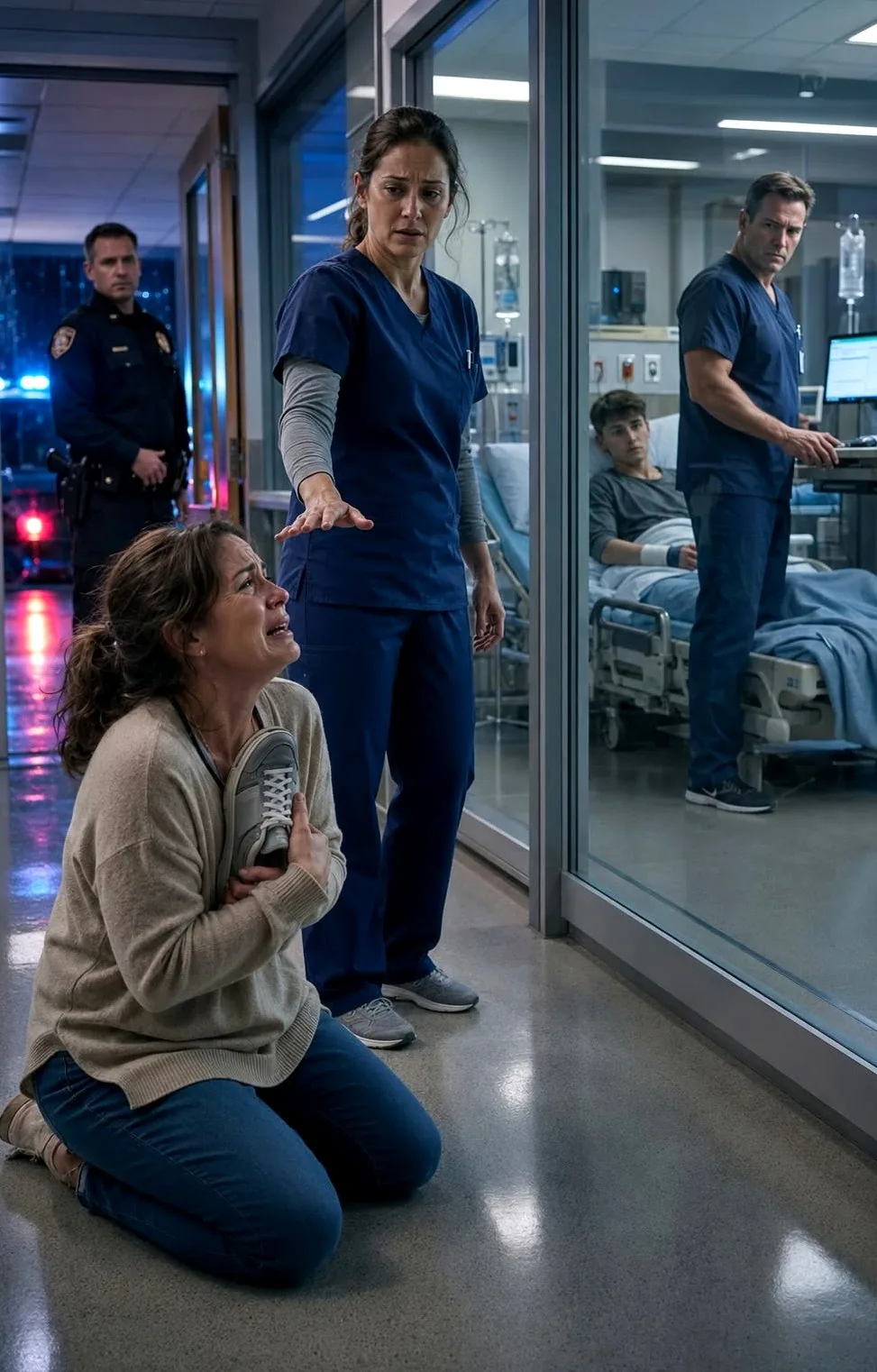
From outside the trauma bay, Jamie Nolan’s mother reached for Maren’s wrist and asked the one thing a grieving parent cannot stop asking. She wanted to know whether her son had been the driver. The police had already suggested he may have caused the crash, and she needed the truth, or at least something close to it.
Ten feet away, Tyler lay under a white blanket and watched through the glass. When Maren met his eyes, he slowly shook his head. That quiet motion carried more weight than any monitor alarm in the room.
Moments later, Tyler leaned toward her and spoke in a voice low enough that only she could hear. “Jamie wasn’t driving,” he whispered. “I was.”
Maren stopped reaching for the pain medication. It was a small pause, but inside a busy trauma room it felt enormous.
“Promise you won’t tell them,” he begged. “You’re my nurse.”
What Tyler Said, and What Maren Could Not Promise
Tyler’s account came in broken pieces, but the meaning was plain. He said he looked at his phone. He said the SUV crossed the center line. He said Jamie grabbed the wheel, but the vehicle still ended up in the ditch. He also said he had called his father afterward, and that call had added a second layer of trouble to the night.
According to Tyler, Dr. Richard Voss told him to say Jamie had been driving. The SUV belonged to Jamie’s mother, and Tyler’s father believed people would accept that version without question. In that instant, the crash stopped being only a medical emergency and became something harder to sort out: a conflict between memory, fear, family loyalty, and consequences.
Maren answered carefully. She could protect Tyler’s medical information, but she could not promise that a court would never ask for it. That boundary mattered, and not just because of policy. It was the line between comfort and certainty, between what a nurse can hold in confidence and what may later belong to an investigation.
Tyler swallowed and tried to undo the moment. Then he said he took it back. Maren told him that he could retract what he said, but she could not pretend the words had never been spoken.
Why the Chart Mattered So Much
At 2:14 a.m., Maren documented the encounter in the chart. Her note was specific and restrained: the patient was awake and oriented to person, place, time, and situation. Before medication, he spontaneously stated, “Jamie wasn’t driving. I was.” She wrote down the words as a record of what was said, not as a judgment about guilt or innocence.
That distinction is easy to miss from the outside, but in an emergency department it is everything. Nurses do not decide cases from a bedside statement, yet they do document what patients say when they are alert and able to speak for themselves. The chart becomes part memory, part shield, and part legal record.
For Maren, the note also captured the tension in the room. Tyler had not been sedated. The syringe on her tray was still sealed. Nothing about the confession came from medication or confusion. It came from a frightened teenager trying to decide whether honesty would help him or destroy him.
The words were not a verdict. They were a record of a terrible moment.
When the Curtain Opened
The curtain snapped back, and an officer stepped into the room to ask Tyler about the crash. The timing could not have been worse. Tyler stared at Maren, then told the officer something very different: that he did not remember anything and that Jamie had been the driver.
In a few seconds, the story in the room split in two. One version lived in the chart, and the other came out of Tyler’s mouth in front of law enforcement. The pressure on him was obvious, but so was the pressure on the nurse standing beside him. Maren was suddenly caught between patient privacy, patient safety, and the reality that nothing said in a trauma bay stays simple for long.
Before the officer could press her for answers, another figure pushed through the doors and turned the room even colder.
The Father in Surgical Scrubs
Dr. Richard Voss, St. Catherine’s chief of surgery, entered wearing dark surgical scrubs and the kind of authority that tends to change the air in a hallway. Tyler went rigid at once. The single word he said—“Dad”—made the family fracture visible to everyone in the room.
Richard did not speak to the officer first. He placed himself between his son and the investigation, then looked past Maren and straight at the open chart. His attention locked onto the one document that could shape the story from that point forward.
“What exactly did you write about my son?” he asked.
It was not only a question about paperwork. It was a challenge, a warning, and a bid for control delivered in one sentence. In that moment, the chart became more than a medical note. It became the center of a family crisis, a possible legal dispute, and a hospital confrontation no one in trauma had expected at 2:14 a.m.
Conclusion
What happened in that room was not just the aftermath of a violent crash. It was the collision of grief, fear, responsibility, and the fragile honesty that can surface in an emergency when a young patient decides to speak. Maren’s note preserved exactly what Tyler said, while the arrival of his father suggested that the hardest part of the night was only beginning.
By dawn, the question would not simply be who was driving. It would also be who gets to control the story when a confession, a chart, and a family are all pulling in different directions.