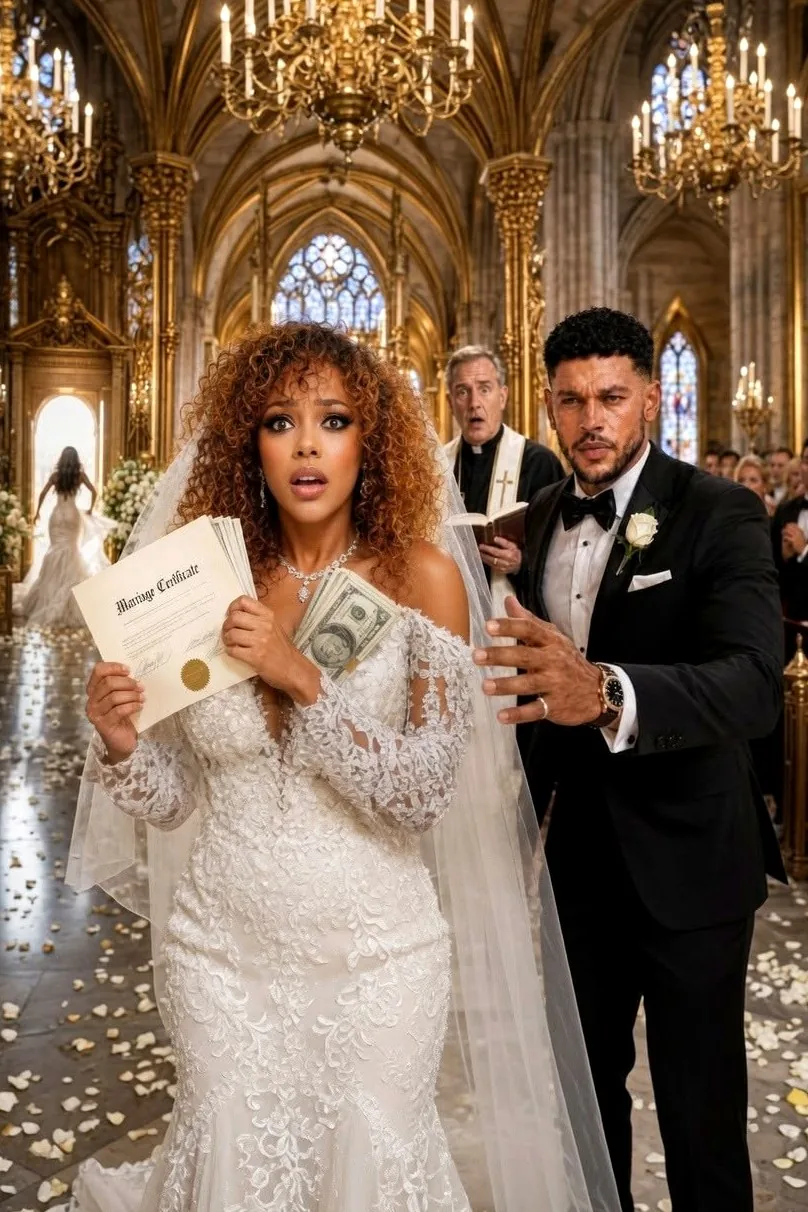
At first, it sounded like the kind of strange but exciting job that only happens in movies: show up, follow directions, and collect a huge paycheck. But when Angela Parker arrived and was handed $20,000, she had no idea she was stepping into a bride role that would blur the line between performance and reality.
What began as a confusing assignment quickly turned into one of those unforgettable moments where every detail felt too polished, too precise, and far too serious to be just a casual project. Angela was told to keep her story straight, stay in character, and trust that everything would make sense later. Instead, the situation only became more puzzling.
A Job That Started With Questions
Angela introduced herself politely, repeating her name with the kind of careful confidence that comes from wanting to make a good impression. The man meeting her confirmed her identity, then handed over the payment and gave her simple instructions: enter the salon, say her full name, and do exactly as she was told.
The amount alone was enough to make anyone pause. $20,000 was not ordinary money for an ordinary day, and Angela immediately understood that this was no small errand. Still, she assumed it had to be part of a production, maybe an independent film or some private shoot that required a convincing bride.
“You’ll be playing a bride. Do you understand?”
Angela answered yes, but she also asked the question that was on her mind: what exactly was this for? Was it a movie? A scene? Some kind of project with a hidden plot? The reply was vague and firm. She did not need to know the details. She only needed to follow instructions.
Inside the Salon, Everything Felt Too Real
When Angela arrived at the salon, the atmosphere was immaculate and strangely serious. The staff welcomed her by name and guided her forward without hesitation, as though they had been expecting her for quite some time. That level of preparation made the whole experience feel more authentic than she expected.
She noticed the care taken with every step. The dress, the tone of the staff, the calm efficiency of the room, and even the way people spoke about the event all suggested something far bigger than a simple stunt. Angela kept telling herself to stay focused and deliver the kind of performance that would impress whoever was watching.
- She was treated like a genuine bride from the moment she arrived.
- The staff followed instructions without hesitation.
- Every detail looked expensive and carefully planned.
- No one seemed to be breaking character, which only deepened her confusion.
Then she heard the whispers. Someone mentioned that the bride was marrying a billionaire, and the room seemed to buzz with admiration. Another comment followed about the Henderson family, making the whole thing sound less like a film set and more like a high-society wedding with serious stakes.
The Bride Role That Felt More Like a Life Change
Angela tried to process what she was seeing. The gown was described as something designed by a world-renowned creator, and the level of luxury surrounding her was impossible to ignore. If this really was a production, then it was one of the most convincing she had ever encountered.
But the more authentic everything appeared, the more Angela began to wonder whether she had understood her role correctly. She had expected a scene, not a full-scale ceremony. She had expected direction, not silence. And she definitely had not expected to be treated like a bride whose arrival carried family expectations, social pressure, and a future already in motion.
“They’re really convincing. Their acting is so natural that it doesn’t even feel scripted.”
That thought captured Angela’s mindset perfectly. She kept assuming that everyone around her was part of the act, and because they behaved so naturally, she became even more determined not to look out of place. If this was a test of realism, she intended to pass it.
At the same time, a different thought kept creeping in: what if this was not really about acting at all? What if she had been brought here for something much bigger than a temporary role? The possibility hovered at the edge of her mind, but she did not yet have enough information to name it.
A Car Arrives and the Uncertainty Grows
Just as Angela was adjusting to the salon’s atmosphere, she was told that her car had arrived. The announcement sounded official, almost ceremonial, and it only made the whole situation feel even more real. She had been prepared, dressed, and positioned like someone about to take part in a major life event.
By that point, Angela’s confusion had become a mix of nerves and curiosity. She was still trying to understand where the performance ended and where the truth began. Every new instruction made her more certain that the people around her were deeply committed to whatever was happening.
Her thoughts raced as she moved forward. Was she simply a bride in a planned scenario? Was the groom waiting at the church? Was she expected to play along until the very last minute? The possibilities were endless, and none of them felt ordinary.
- She had been paid in advance, suggesting trust and urgency.
- The salon staff behaved as if the ceremony were legitimate.
- The car waiting outside made the event feel complete.
- Angela still had no clear explanation for the assignment.
Even so, she remained professional. Whatever was coming next, she intended to handle it with grace. She had been given a role, and for the moment, she was determined to play it as well as she could.
When a Performance Starts to Look Like Reality
What made Angela’s experience so compelling was not just the money, but the atmosphere of certainty around her. No one acted rushed. No one seemed confused. Every detail suggested that the day had been planned long before she walked through the door.
That is what made her wonder most: if the job was supposed to be a movie scene, why did it feel like a real bride was being escorted through a real wedding day? The question became harder to ignore the longer she stayed in character.
She had entered the assignment expecting a temporary role and perhaps another opportunity if she impressed the right people. Instead, she found herself standing inside a situation so polished and so elaborate that even she began to doubt her own assumptions. The line between acting and reality was no longer clear.
Conclusion
Angela Parker walked in expecting a strange but straightforward gig. She left the salon with far more questions than answers, carrying the unsettling feeling that the bride role she accepted was tied to something much more real than she had first imagined.
Whether it was a hidden test, a private ceremony, or an unexpected twist in a much larger plan, one thing was certain: for Angela, the day had already become unforgettable. What started as paid performance had turned into a story she would never tell lightly, because some jobs do not just ask you to play a part—they make you question the entire script.