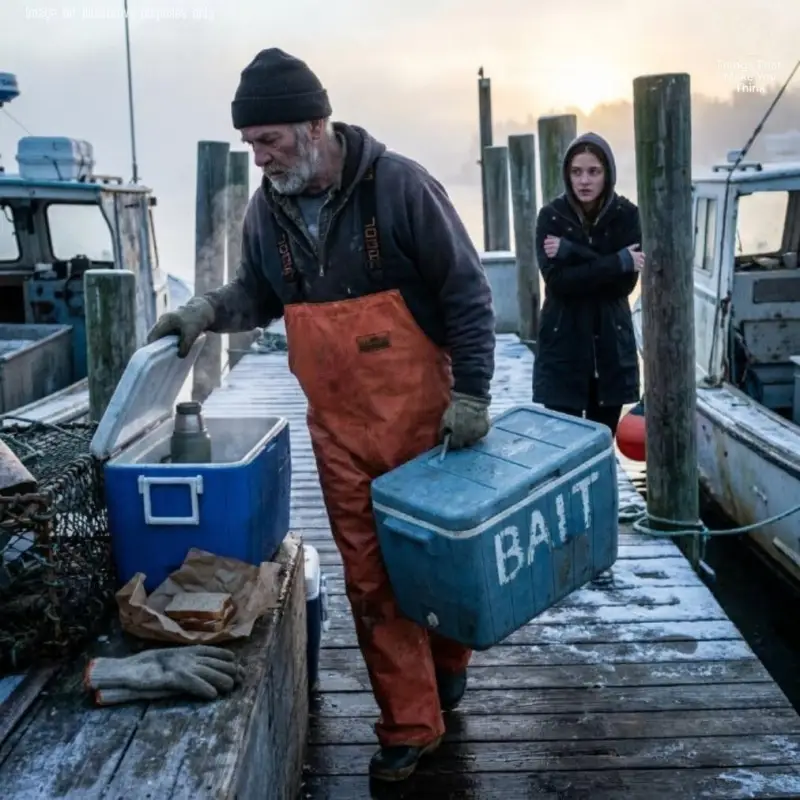
A Cold Morning on the Dock
The wind off the Atlantic in late November cut through Pier 4 like a blade. For forty years, I had worked that dock, hauling traps and keeping to myself. At sixty-eight, I had learned that the sea respects no one, and the best rule was simple: keep your head down and mind your own business.
That morning, though, I noticed a young woman huddled near the pilings. She was thin, trembling, and dressed in a jacket far too light for a Maine winter. She looked no older than nineteen, and the fear in her eyes was easy to recognize. It was the look of someone who had nowhere safe left to go.
The First Offering
I am not a man known for soft words. If I had approached her directly, she likely would have run. So instead, I cleaned out my old blue cooler, the one with “BAIT” written across the lid in faded black marker. I filled it with what I could spare: hot clam chowder, a ham sandwich, and my own spare wool gloves. Then I set it beside the pilings, cracked the lid open, and went back to work without saying a word.
When I returned that evening, the thermos was empty, the gloves were gone, and in their place sat a small wooden seagull, carved by hand. I slipped it into my pocket and understood that she had accepted the gift in the only way she could.
Sometimes the kindest things are the ones offered quietly, without forcing anyone to say thank you.
A Quiet Exchange
The next day, I brought more food, a blanket, and dry socks. Again, everything disappeared by evening. Again, the cooler held something left behind in return. This silent exchange continued for three weeks.
- Hot meals appeared in the cooler every morning.
- Warm clothing was added little by little.
- Small carved keepsakes replaced what was taken.
Word spread along the waterfront, as words always do. Big Mac, a giant diesel mechanic with a temper to match his size, saw me stocking the cooler one morning. He said nothing. The next day, the cooler already held a new pair of women’s insulated boots and a fifty-dollar bill taped neatly to the toe. After that came hand warmers, groceries, and more clothes than I could count.
By the end of the month, the roughest men on the pier had become quiet helpers. Men who barely spoke to one another were suddenly showing up before dawn to leave cash, canned goods, and warm layers in the old blue box. No one made speeches. No one asked for praise. We just did what needed doing.
What the Cooler Became
The girl’s name, I later learned, was Elara. One February morning, she stopped appearing. The cooler went untouched, and though we worried, there was no way to know where she had gone. The sea teaches hard lessons: not every answer is given, and not every story ends where you expect.
Still, we never moved the cooler.
Over time, the “Bait” cooler became something bigger than any one of us. If a deckhand was short on groceries, a gift card would appear inside. If a man was sleeping in his truck, he might find a sleeping bag waiting beside his tires. The box became a private promise among working people who understood hardship and refused to let one another disappear into it.
The Final Surprise
Ten years passed. My back gave out, and I sold my boat on the day I had dreaded for years. On my last afternoon at Pier 4, I went to collect my things and take the cooler home. But when I reached my spot, I stopped short.
A crowd had gathered. And beside the old blue cooler stood someone I never expected to see again.
It was Elara.
She was no longer the frightened girl under the pilings. She stood taller now, steady and warm-faced, with the same quiet strength in her eyes that had once asked for help without words. She had returned not empty-handed, but with gratitude, dignity, and a story of her own.
In the years that followed, what began as one man’s small act of mercy became a tradition of care for an entire dock. That battered blue cooler reminded us all that kindness does not need an audience to matter. Sometimes, it only needs a lid cracked open just enough to let hope in.
In the end, the coolest thing on Pier 4 was never the cooler itself. It was the way a whole community learned to look after its own.