A quiet park filled with grief
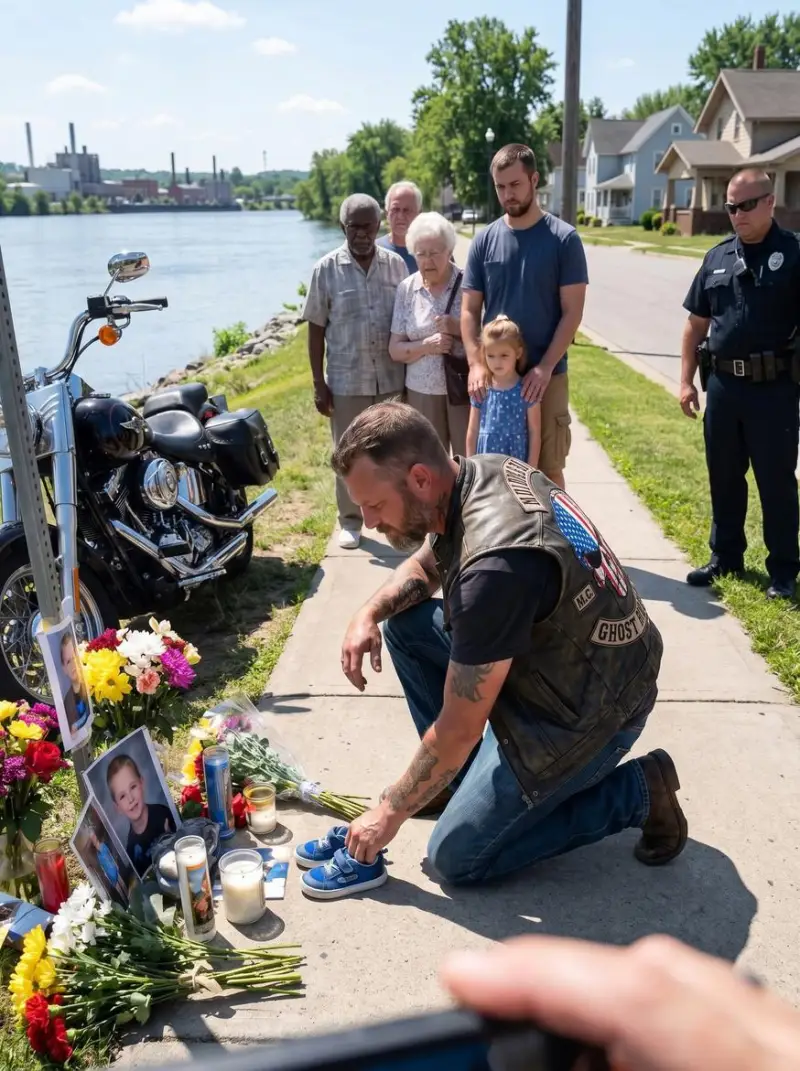
Riverside Park had never felt so heavy. A low fog hovered above the water, and the river moved with a strange stillness, as if the whole place had paused to mourn. Along the concrete path, a temporary memorial had been built with flowers, candles, handwritten notes, and small keepsakes placed with trembling care.
A young boy had been lost before sunrise. He was remembered by the community as a second grader who loved dinosaurs and blueberry pancakes, and his bright photo now stood among the candles, surrounded by tears and silence. Parents held their children a little tighter. Strangers lowered their voices. Even the cameras kept their distance.
The man in leather who did not belong
Then the sound of an engine drifted into the park.
It came slowly, steady and controlled, until a lone biker appeared. He was a white man in his early forties, broad-shouldered, with a sleeveless leather vest, tattooed arms, dark hair, and a neatly trimmed beard. Heavy boots struck the pavement with measured steps. He did not look like anyone the crowd expected to see there.
That was part of what unsettled people. He looked out of place, and in a space built around shared grief, that made every movement feel louder than it was.
- Some parents instinctively drew their children closer.
- An elderly woman frowned and whispered to someone beside her.
- Several people stared, unsure whether to be angry, confused, or afraid.
Still, the biker kept walking until he reached the front of the memorial.
The small shoes beside the candles
Without speaking, he unfastened a saddlebag and removed a pair of tiny blue children’s shoes. The laces were tied neatly together, and the shoes looked clean, carefully kept, and deeply personal. The sight changed the mood in an instant. Confusion spread first, then concern, then suspicion.
Phones rose into the air. People began to murmur. Was he making a statement? Was this some kind of attention-seeking gesture? Why would he bring something like that here?
Instead of answering, the man knelt down and placed the shoes beside a candle and a stuffed teddy bear. Then he bowed his head and stayed there in silence.
“Sir, step away,” an officer warned. “You’re not allowed to disrupt the memorial.”
The biker did not argue. He did not apologize. He did not explain himself. He simply remained where he was, one knee on the ground, looking toward the river as though he were listening to a memory no one else could hear.
Why he would not move
That stillness changed everything. The crowd’s unease began to soften, because his silence no longer looked like defiance. It looked like pain. It looked like someone standing in a place where grief had once entered his own life and never truly left.
People who had been ready to judge him started to wonder if the shoes were a tribute, perhaps tied to a loss he had carried quietly for years. The officer watched him more carefully. The memorial, once filled with suspicion, began to feel like a space where another unseen story had been laid down beside the child’s candles.
- The biker was not there to disturb the gathering.
- He was there to honor something deeply personal.
- His refusal to move came from sorrow, not defiance.
In the end, what unsettled the crowd most was not the leather vest, the tattoos, or the silence. It was the realization that grief often arrives in forms we do not expect, and that compassion can look unfamiliar before it is understood.
Sometimes the most meaningful tribute is also the quietest one. In that park, among the candles and flowers, a pair of small shoes said what words could not: some losses are shared, even by strangers.