The Salute at the Funeral
The first words my father spoke to me at my grandfather’s funeral were not a greeting, nor a condolence, but a jab meant to wound.
“So, the Army still hasn’t realised it already has enough doctors?”
He said it loudly, with no concern for who might hear. Arthur Vance had always preferred public humiliation over private cruelty. Around us, the reception hall at the Army Navy Country Club was filled with retired commanders, defence contractors, political advisers, and government officials. My grandfather, General Marcus Vance, had been laid to rest less than an hour earlier, and yet my father seemed determined to turn even this solemn day into a performance.
I stood before him in my full dress uniform, my gloves tucked neatly beneath one arm, the last traces of rain still drying on my shoulders. “Hello, Dad,” I said, keeping my voice steady.
His gaze moved over my medals, ribbons, and Medical Corps insignia. Then the familiar look of superiority settled onto his face.
“The family doctor has finally decided to visit,” he said. “Should we all line up for painkillers?”
A nearby contractor laughed. My younger brother, Julian, quickly joined in, lifting his whiskey glass with a smirk. “I didn’t know Army doctors were allowed outside military hospitals.”
“They are,” I replied. “Usually for funerals.”
His smile faltered for just a moment, and that tiny crack in his confidence felt like a victory. It had taken years, but I had learned to notice those small moments.
A Room Full of Watchful Eyes
The reception looked like every Vance family gathering I remembered: crystal chandeliers, elegant flowers, expensive suits, and conversations that sounded polite until you listened closely. My stepmother, Victoria, moved gracefully through the room, carefully avoiding me whenever our paths came near. I reminded myself why I had come. Not for Arthur. Not for Julian. Not for Victoria. I was there for my grandfather.
Then the room changed. Voices lowered. Men straightened their jackets. A senator near the bar suddenly looked more attentive. Someone important had arrived.
Deputy Assistant Secretary of Defense Harrison Reed entered the hall with three federal security officers. My father saw him at the same time I did, and the smugness vanished from his face.
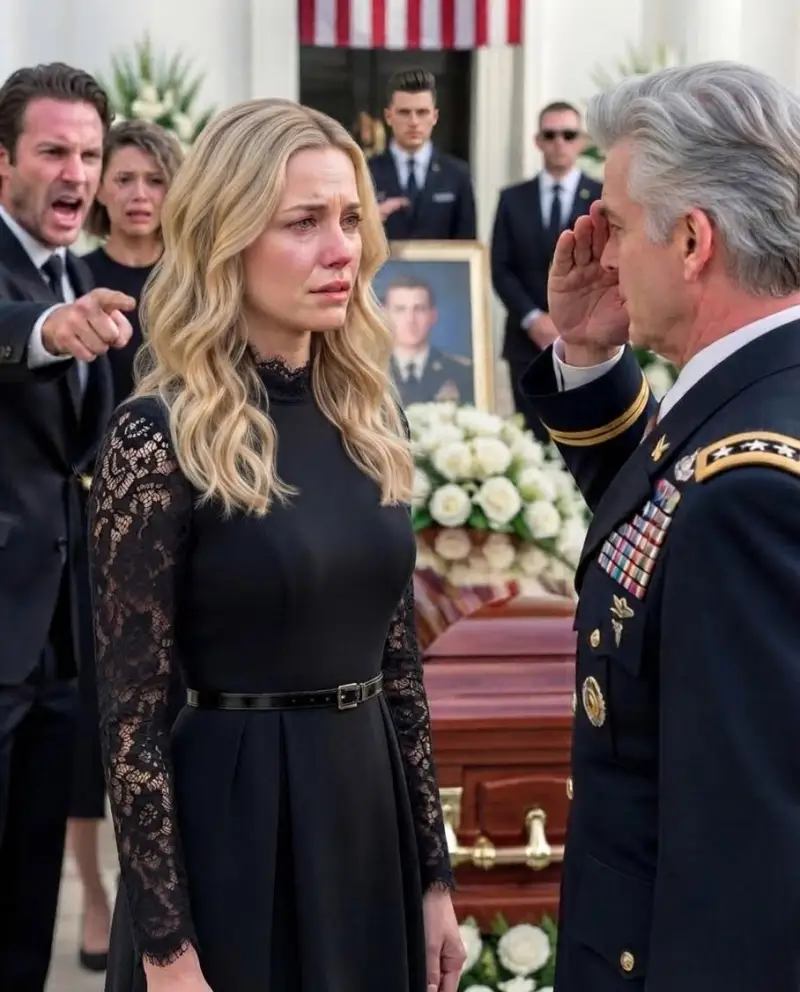
Reed crossed the room without hesitation. He did not stop to acknowledge Arthur or Julian. He came directly to me, stood at attention, and raised a sharp military salute.
I returned it instinctively.
“Colonel Vance,” Reed said, his voice clear and formal. “It is truly an honour to see you again.”
“The soldiers from Kandahar still speak about what you did for them.”
The words settled over the room like a sudden silence. My father looked at me again, but this time there was no mockery in his expression. For the first time, he seemed to be seeing not a disappointment, but a life he had never bothered to understand.
The Note in the Rain
Reed explained that he had come to honour my grandfather, who had spoken of me often in his final days. That revelation struck harder than any insult Arthur had ever thrown at me. My grandfather and I had not been close in recent years, and yet he had remembered me.
Later, Arthur cornered me near the hallway. “How do you know Harrison Reed?” he demanded.
I looked at him and felt something quietly change inside me. I was no longer the frightened girl who had spent her childhood chasing his approval.
“You meet powerful people,” I said softly, “when you stand beside them on the worst day of their lives.”
Then I walked out into the cold rain. I had barely reached the stone steps when Reed followed me outside, carrying two cups of coffee. He handed one to me, then opened his other hand.
In his palm was my grandfather’s old silver lighter. Attached beneath it, with a strip of yellowing tape, was a folded note addressed to me in my grandfather’s handwriting.
- My name was written on the note: Clarissa.
- The lighter had clearly been kept safe for years.
- The message suggested my grandfather had left behind more than memories.
As I held the note in my shaking hands, I understood that the funeral was not the end of my grandfather’s story. It was the beginning of something he had planned long before his death, and something he had quietly set in motion for me to discover.
In that moment, I realised my grandfather had left me one final lesson: sometimes the truth arrives only after silence, and sometimes respect comes from the people you least expect.