A Sunday Walk That Changed Everything
I had built my life on speed, ambition, and control. At thirty-eight, I ran one of Manhattan’s largest commercial real estate firms, moved from private jet to boardroom, and wore success so naturally that even my failures were hidden behind polished language and expensive tailoring. Yet on a quiet Sunday morning, my mother, Eleanor, asked me for the one thing I never made time for: a walk in Central Park.
I agreed, more out of guilt than affection. We strolled near The Lake, where runners passed us, coffee steamed from paper cups, and families drifted along the paths with easy laughter. My mother, elegant in her scarf and familiar floral perfume, held my arm and said softly, “People are living, Arthur. You only exist.”
I was about to dismiss her words when I saw her on a bench beneath a large oak tree.
The Woman I Left Behind
At first, she looked like any exhausted stranger asleep in the cold. But then I noticed the shape of her face, the line of her hand, the stillness that I knew too well. My heart stopped.
It was Madeline Hayes.
The woman who had loved me five years earlier, back when my dreams were smaller and my life was unfinished. I had left her waiting one night, telling myself that ambition justified the delay, then the next, until our relationship became a memory I buried under success.
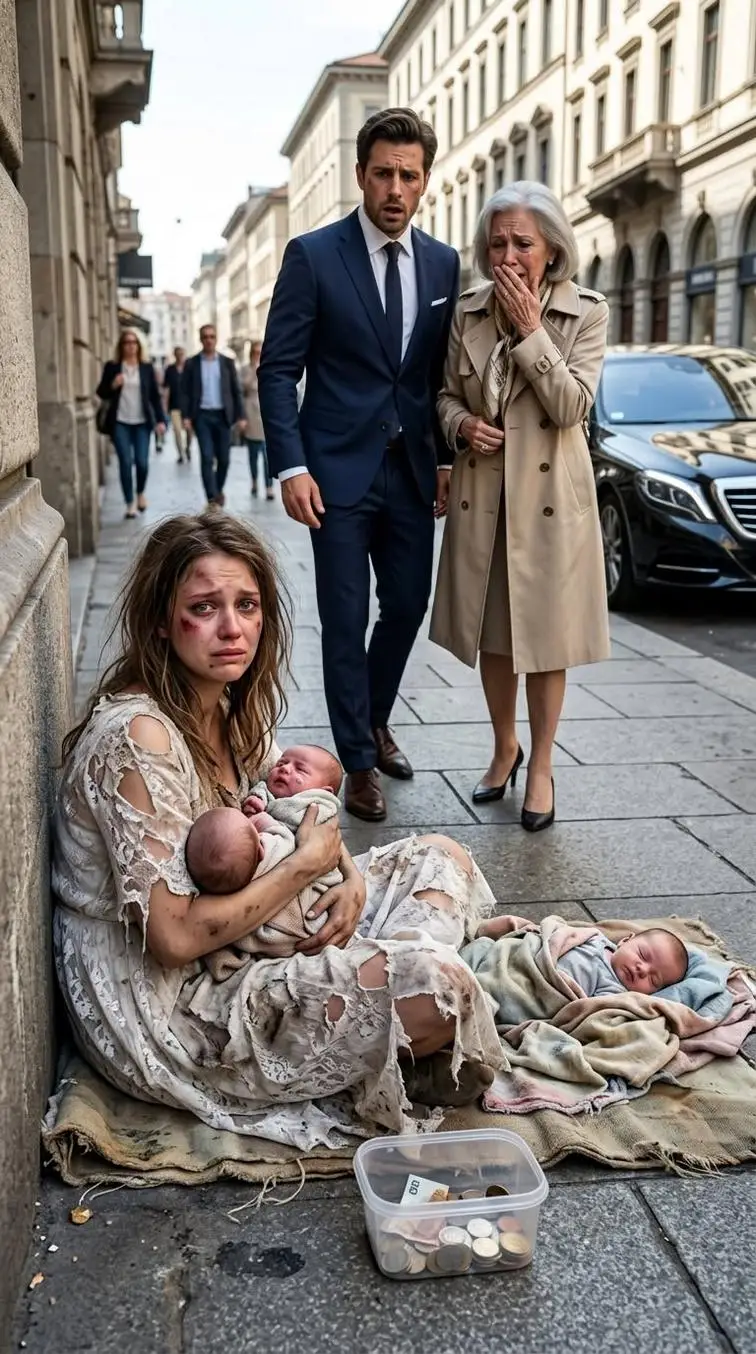
Madeline was pale and shivering, clutching three babies close to her chest. Three tiny children wrapped in thin blankets, pressed against her like fragile proof of a life I had never imagined.
One small movement changed everything: a baby’s hand slipped from the blanket, and I saw a familiar dimple on the knuckle — the same mark I had carried since childhood.
My breath caught. I looked at Madeline, then at my mother. Eleanor’s face had gone pale. Not surprised. Afraid.
“Tell me the truth,” I said, my voice breaking. “Did you know?”
My mother looked away and whispered, “Arthur, let’s go.”
That was the moment Madeline woke. She sat up instantly, pulled the babies tighter, and looked at me with guarded fear.
“Don’t come near us,” she said.
Her words struck harder than any accusation. “Madeline,” I asked, stunned, “what happened?”
She gave a bitter laugh. “You really came here to ask me that?”
The Envelope and the Truth
I turned back to my mother, who now looked as if the bench beneath us had turned to ice. “Are those children mine?” I asked.
After a long silence, Eleanor closed her eyes. When she answered, her voice trembled with something deeper than fear.
“Yes,” she said. “But that is not the worst part.”
I knelt in the damp ground without caring about my suit, my status, or the people walking past us. All that mattered was the woman in front of me and the three children watching with wide, uncertain eyes.
“Madeline,” I said quietly, “I never knew. I never received anything. I would never have ignored this.”
She glanced toward Eleanor before reaching into a worn diaper bag and pulling out a folded envelope. The corners were soft from being carried too long, as though it had been waiting for this moment. She held it for a second, then placed it in my hands.
- It was old, creased, and sealed long ago.
- My name was written on the front in familiar handwriting.
- Whatever was inside had been hidden from me for years.
I unfolded the paper inside and looked at the signature at the bottom. The blood drained from my face. The name on that page was the beginning of a truth I was not prepared to face — and, as I would soon learn, only the first part of a much larger betrayal.
That morning in Central Park, I thought I had found the worst surprise of my life. I was wrong.