The refrigerator was humming when I got home, the kind of ordinary sound that makes survival feel real. I had barely set down my duffel bag before my father called to remind me, once again, that in his eyes I was a disappointment in uniform.
By Thanksgiving night, he had made his choice: my sister’s billionaire fiancé, polished family optics, and a dinner table with no place for the daughter who came home from war.
The Call That Set Everything in Motion
My apartment in Boston was small, quiet, and tired in the way a person can be tired after too many hard weeks and not enough sleep. It smelled like coffee, detergent, and the beef stew I had forgotten in the microwave two nights earlier. My boots still carried desert dust in the seams, and my body still ached where shrapnel had torn into my side.
Then my phone rang. It was my father, and I answered the way daughters often do before they learn that love does not always sound like love.
He did not ask if I was safe. He did not ask how I was healing. Instead, he opened with comparison.
“Why can’t you be like your sister, Maria?”
Vivian, he said, knew how to make the family proud. I only brought “mud, trauma, and that cheap Army title” wherever I went. He spoke as if service were a stain and sacrifice were an inconvenience.
When he mentioned that Vivian was bringing Derek Hartwell home for Thanksgiving, the message became clear. Derek was not just a boyfriend in my father’s mind. He was a billionaire investor, a man with senators in his contact list and defense connections on speed dial. That, apparently, was what counted as a real life.
The Daughter They Wanted to Forget
My father had always loved appearances more than truth. He could turn cruelty into “standards” and abandonment into “good judgment” with a few clipped words and a practiced tone. The worst part was not that he insulted me. It was how casually he erased the people I had lost.
Three days earlier, Sergeant First Class Rowan had died with his blood soaking my sleeve. Staff Sergeant Elena Petrov had stopped breathing in the back of a medevac helicopter. Specialist Mateo Cruz, only twenty-two, had pushed me out of burning wreckage before the roof came down on him. To my father, they were not names. They were not lives. They were just part of the background noise he had no interest in hearing.
On my dresser, my dog tags lay beside a velvet box I had barely opened. Inside was the Silver Star I had been awarded for pulling four soldiers out of a kill zone. The award had come with clean paperwork, official signatures, and a date stamped in military precision. None of that mattered to my father.
He was too busy telling me not to show up and embarrass the family.
“Do not make yourself a victim, Maria. Just be useful for once and disappear.”
That was where the call ended. Not with concern. Not with regret. Just a hard click and a silence so sharp it felt like another wound.
What He Did Not Know About Me
For a moment, I stood in the center of my apartment and let the old hurt rise. Then the training kicked in, slow and exact, the way it always did when panic tried to take the wheel. I unpacked my bag. I folded my clothes. I lined my boots by the door. I checked the lock twice. I breathed.
My father loved calling me poor, like money was the only language worth respecting. What he did not know was that deployment pay, combat bonuses, and careful investments had been stacking quietly for years. He had no idea I owned properties under a private LLC, or that I could buy the image he worshiped and still have change left over.
That did not make me reckless. It made me patient. Money, like ammunition, is something you keep clean, counted, and ready. You do not wave it around just because someone has insulted you.
So I said nothing. I sat at my kitchen counter, ate the cold stew he would have laughed at, and watched the city go dark beyond my window. The apartment was silent except for the radiator ticking and the snow tapping lightly against the glass.
Thanksgiving Without a Seat for Me
At 8:04 p.m., Vivian posted a photo in the family group chat. The dining room looked warm and expensive, all candlelight, crystal glasses, and a roast turkey arranged for admiration. Dad was smiling in a charcoal suit beside Derek Hartwell, as if he had personally designed success. Vivian wore cream and sat close enough to Derek to look like she belonged to the life my father had chosen over mine.
There was no empty chair. No plate with my name on it. A flower arrangement filled the place where I would have sat.
Then my father texted:
Thank you for not ruining the evening. Derek was impressed by our family pedigree.
I read it once. Then again. The message was not only cruel. It was deliberate. He had not merely excluded me from dinner; he had turned my absence into a triumph.
I did not reply with tears or an argument. I simply took another bite of cold stew and let the truth settle in. Some families do not break loudly. They just make room for everyone except the person they keep forgetting is still alive.
The Order That Changed the Night
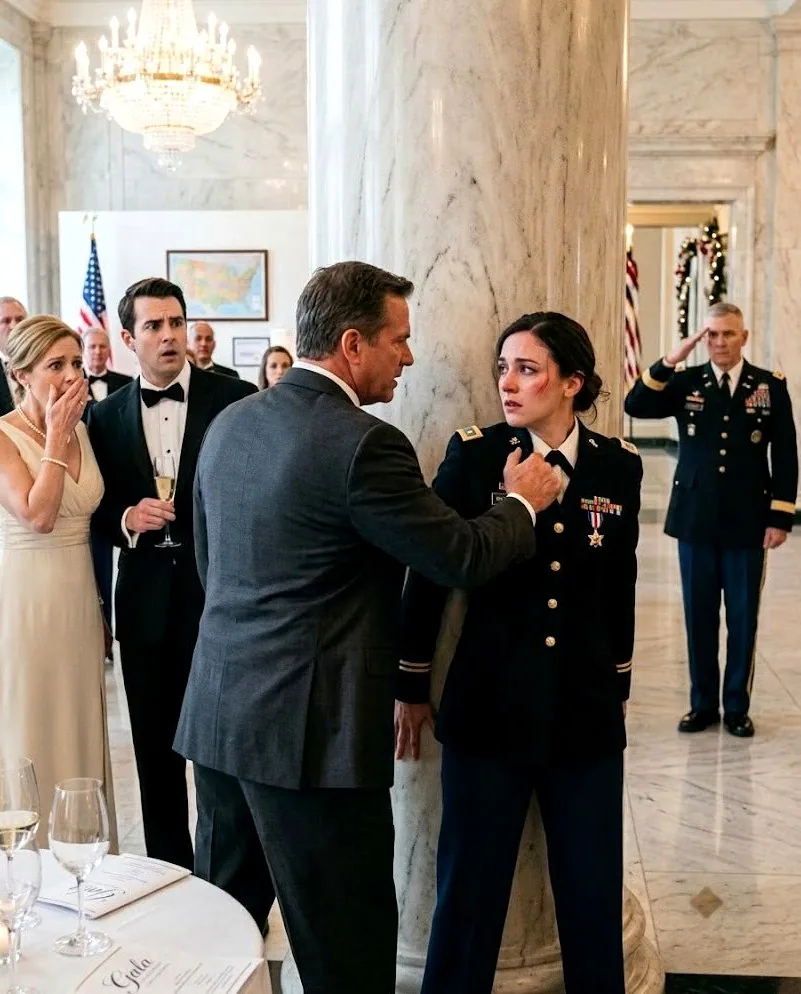
At 8:11 p.m., another message appeared, this time from Colonel Margaret Caldwell. Her question was simple and impossible to ignore: why was my name missing from the Beacon Hill Winter Gala RSVP list?
The gala was not just another formal event. It was the event, the one where Pentagon leadership, defense contractors, politicians, old money, and new money all gathered under glittering chandeliers to smile for cameras and trade power in polished voices. My first instinct was to decline. I was not in the mood for silk, small talk, or any room full of people pretending that honor could be bought.
My answer was polite. Her response was immediate.
She did not let me hide. She reminded me, in no uncertain terms, that I had earned my place there. I had been awarded a Silver Star for pulling four soldiers out of a kill zone. I would not sit alone in my apartment while people in expensive clothes applauded themselves.
Her words landed harder than my father’s insult ever could, because they were built on the one thing he had refused to see: what service cost.
When I agreed to go, I knew the night would not be easy. But I also knew this was no longer about a dinner invitation. It was about Rowan, Petrov, Cruz, and every person who had come home wrapped in a flag or not come home at all.
The Knock at the Door
I was still standing in my kitchen when the knocks came. Three hard hits on the door, heavy and impatient, split the apartment’s silence wide open. I checked the peephole and saw my father in his good wool coat, with Vivian beside him, arms folded, expression sharpened into disapproval.
He had not come to apologize. That was obvious before I even opened the door. His face carried the same polished anger he always wore when he wanted control more than connection.
The timing told me everything. He had seen my name missing from the house, or heard that I had not been included, and decided to come over before I could make my own choice. He wanted to finish the conversation on his terms, in my doorway, where he could still pretend he outranked me.
But things were different now.
I was no longer the quiet daughter standing in the back of a family photo. I was no longer the child made to feel small beside a sister who knew how to shine in the exact way he admired. I was a decorated officer, a survivor, and a woman who had learned what it meant to stand alone without falling apart.
My father had come to finish what he started. He had no idea the room was already changing around him.
When I opened the door, the cold air rushed in from the hallway, and with it came the feeling that the night had finally turned. Whatever he had planned—shame, demands, another round of humiliation—would have to collide with the truth I had spent years earning in silence.
Conclusion
Some people only notice a daughter when she is useful to their image. Others discover too late that the child they dismissed has become someone they can no longer control. I had spent years surviving both war and family, and the second was often the harder battlefield.
That Thanksgiving did not begin with applause. It began with exclusion, bitterness, and a father who mistook status for worth. But by the time the night unfolded, the balance of power had already shifted. The daughter he tried to erase was walking into the gala he never thought she deserved—and the people in that room were about to learn exactly who she was.