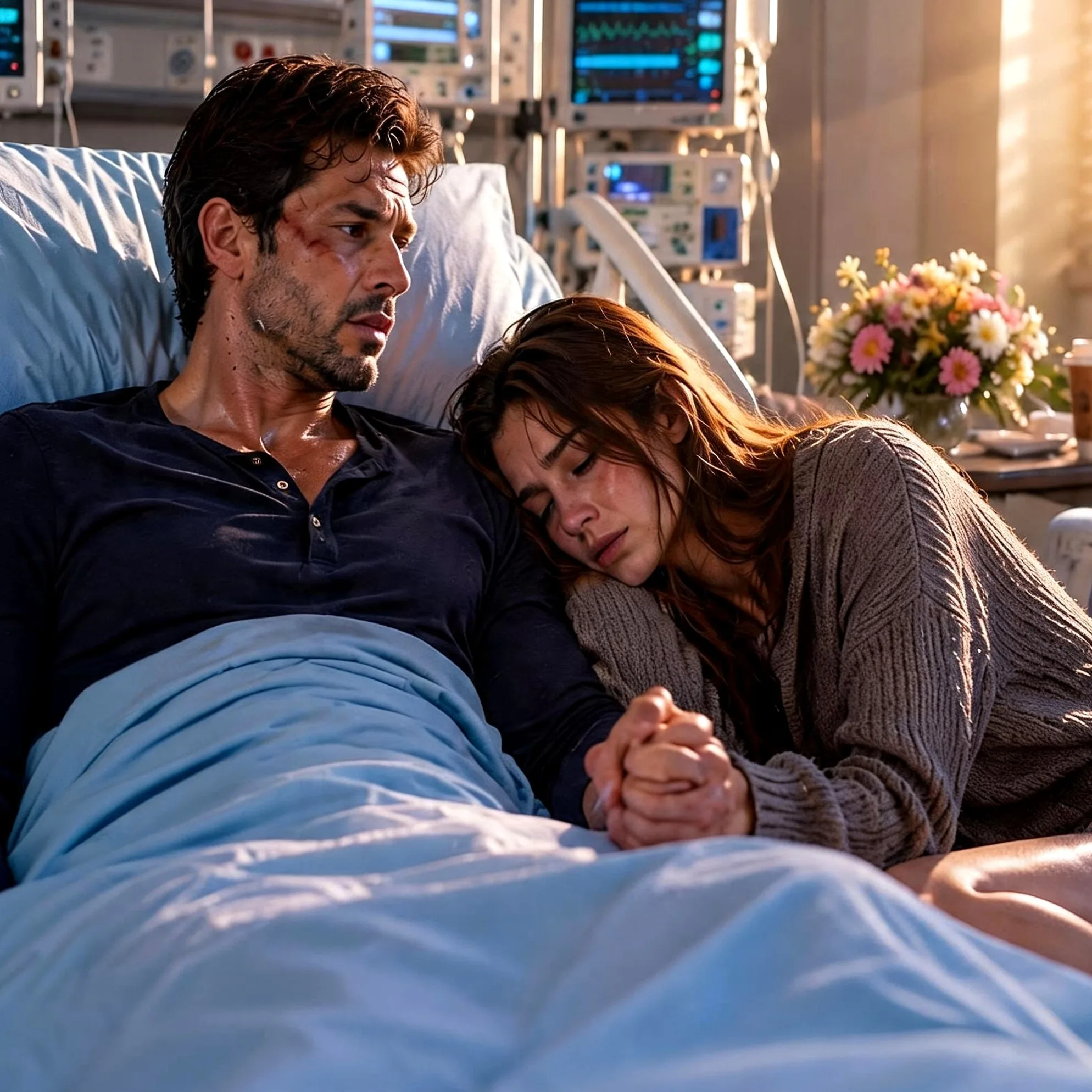
The first sound I heard after slipping back into consciousness was quiet crying. It was not dramatic or loud, just the kind of exhausted grief that sounds as if someone has been holding themselves together by force for far too long. When my eyes finally opened, I found myself in a hospital bed, wrapped in pain, and holding the hand of a woman I barely knew.
Her name was Soraya Vale. She was asleep in a chair pulled too close to my bed, her fingers still locked around mine, her face pale with exhaustion. In that instant, before memory fully returned, I understood only one thing clearly: she had not left me alone. And somehow, that felt more overwhelming than the pain in my ribs.
The hospital room and the face I did not expect
The room came into focus slowly. Antiseptic hung in the air, sunlight slipped through the blinds, and machines kept up their steady rhythm beside me. My left leg was elevated, my shoulder was braced, and my body felt like it belonged to a stranger. Every breath hurt. My throat burned. Even lifting my head felt like work.
Then I looked to the side and saw Soraya. Her usually neat hair had fallen loose, dark circles sat beneath her eyes, and a paper coffee cup near the window looked untouched. She looked like someone who had spent the night fighting a battle she could not afford to lose.
Three months earlier, she had been nothing more than the woman across the hall.
- A polite nod in the corridor.
- A quiet greeting by the mailboxes.
- A neighbor with brown eyes that seemed to carry a storm she never named.
How grief turned a full life into silence
My name is Cashen Roe, though most people call me Cash. By the time I was thirty-six, I had become very practiced at being alone. Not because I wanted to be, but because life had slowly taught me to expect absence.
First my father died of a sudden stroke. Not long after, my mother followed. People often speak of heartbreak as if it is a poetic thing, but what I learned was simpler and harsher: sometimes grief keeps taking until even the air in a home feels different. My mother did not leave the same way my father did, yet something in her had already gone when he was gone.
After that, my apartment turned into a museum of what I could not bring myself to throw away. My father’s old compass stayed in a drawer. My mother’s recipe cards stayed in a box. A cracked blue mug from a family trip remained on a shelf like a quiet witness.
I worked from home as a civil design consultant, drawing safer roads, cleaner intersections, and pedestrian routes meant to reduce danger. I spent my days making cities less careless while my own life became quieter and smaller. At first, friends called often. Then less often. Then not at all.
Grief makes people uncomfortable when it does not arrive on schedule, and I had been carrying mine long enough for others to start looking away.
The broken elevator that changed the rhythm of my days
Soraya entered my life because of a broken elevator. It was a bright Tuesday afternoon when the building trapped us between floors, somewhere between the fourth and fifth, with flickering lights and no clear answer about when help would arrive. I had groceries in one hand and eggs tucked under my arm. She had coffee, flowers, and a canvas bag full of vegetables.
At first we stood there in awkward silence, both of us pretending the situation was merely inconvenient. Then she laughed softly and said the building had finally found a way to make neighbors talk. It was such a small remark, but it changed the entire mood inside that metal box.
For forty minutes, we talked about ordinary things: the old pipes, the downstairs neighbor who fed pigeons like royalty, the stairwell smell after rain, the landlord’s habit of only fixing things after threats of legal action. Then the conversation shifted, almost naturally, into something more personal.
She told me she worked at a community children’s center. I told her I designed traffic routes and crosswalks. She said cities were full of invisible people. I admitted I understood that more than I wanted to.
After that day, our lives began to overlap in small, careful ways. Nods became conversations. Conversations became coffee. Coffee became evening walks when the light was warm and the sidewalks glowed gold.
What Soraya carried behind her calm
Soraya never rushed my grief. She never tried to fix it with empty phrases or impatient optimism. When I spoke about my parents, she did not offer the usual remarks people use to smooth over pain. She listened instead, and sometimes that is a rare and generous kind of comfort.
Over time, she let pieces of her own story slip into our conversations. There had been a canceled wedding. A man named Orion. An accident. A family that told her to move on before she was ready. I could hear the weight of what she did not say as clearly as the things she did.
Some nights we sat on the rooftop and watched the city move below us. Whenever an ambulance passed, Soraya would tense. Her fingers would close around her cup. Her face would go still, as if she had been pulled into a place I could not reach.
I wanted to ask more. I wanted to help. But I had learned that some wounds do not open because someone is kind. They open only when trust decides to let them breathe.
She had the kind of sadness that did not ask for attention, only patience.
The rain, the intersection, and the moment everything changed
The day of the accident began with sunlight and ended with sirens. In the late morning, Soraya knocked on my door with two paper cups of coffee and an invitation to help at the children’s center. They were holding a charity drive for families affected by an apartment fire on Delancey, collecting school supplies and clothing.
I tried to refuse. I had deadlines and a backlog of work. Soraya waved that away with the confidence of someone who knew I was making excuses.
At the center, she seemed lighter. She wore a loose beige sweater, denim shorts, and white sneakers, and her chestnut hair moved in the breeze as she knelt beside children painting paper suns and tying ribbons around donation boxes. I watched her guide a shy boy toward a yellow crayon without pushing him to speak or perform gratitude. She just stayed beside him until he smiled.
That was the moment something shifted inside me. Not like thunder. Not like a confession. Just a quiet realization that my days had become brighter because she was in them.
By late afternoon, the sky changed quickly. Clouds gathered. The air turned heavy. Rain came down so hard the sidewalks looked silver, and thunder rolled between the buildings. We ducked under a narrow awning near an intersection, soaked and breathless.
Then an ambulance screamed past us.
Soraya’s expression changed immediately. Her smile disappeared. Her hands began to tremble. When I said her name, she answered too quickly, insisting she was fine. But the look in her eyes told a different story.
We stepped into the crosswalk with the other pedestrians when the light changed. Halfway across, I heard the sound that split everything in two: a truck horn, tires skidding, someone shouting.
A delivery truck was sliding through the intersection, its rear swinging wildly on the rain-slick road. It was headed directly toward Soraya, and she froze. She did not move. For one terrible second, it was as if she had left the street entirely and been pulled back into some other memory, one that had no room for escape.
I did not think. I only moved.
I grabbed Soraya and shoved her toward the sidewalk with everything I had. She fell clear of the truck’s path. I was not so lucky. The impact threw me across the pavement, and the world became metal, rain, and pain. I remember the taste of blood, the flash of red lights in the storm, and Soraya crawling toward me while screaming my name.
She pressed her hands against my chest as if she could keep me here by sheer force of will. I wanted to tell her not to cry. I wanted to tell her I was still there. But my body would not cooperate, and the dark came before I could say anything at all.
A quiet kind of ending, and a beginning too
When I woke up in the hospital, Soraya was still there, still holding my hand like she had never once considered letting go. That was when I understood the shape of what had happened between us. We had started as neighbors, then become companions, and in a matter of seconds at that intersection, she had become the person whose presence mattered most.
Not every meaningful bond arrives with dramatic promises. Some arrive through broken elevators, shared coffee, patient listening, and the steady decision to stay. Soraya stayed when I was grieving. I stayed when her pain surfaced in silence. And when the rain finally washed the street clean, what remained was not just survival, but connection.
Even in a hospital room filled with pain and uncertainty, that connection felt like proof that people can still find one another in the middle of ordinary days and become something unforgettable. In the end, I did not wake up alone. I woke up to the truth that the woman I barely knew had become the one person I could not imagine facing life without.