Chicago knew him as Stone: the man who never blinked, never begged, and never broke. But on a freezing night in Cicero, the city’s most feared mafia boss found himself trailing a three-year-old girl through the dark—and what he discovered behind a battered apartment door reached farther than bullets ever had.
A Night That Changed Everything
Close to midnight, my old black Lincoln was parked across from a crumbling apartment building while little Emma Romano climbed five flights of stairs alone. I told myself I was only making sure she got home safely. It was a lie I had repeated often enough that it almost sounded true.
There was something about the way she moved—small shoulders lifted against the cold, one hand gripping the railing, the other clutching her doll—that kept me watching longer than I should have. She never looked back. She never hesitated. She just kept climbing, as if the world had already taught her that no one was coming to help.
For the first time in three years, the man Chicago feared as Stone cried in silence.
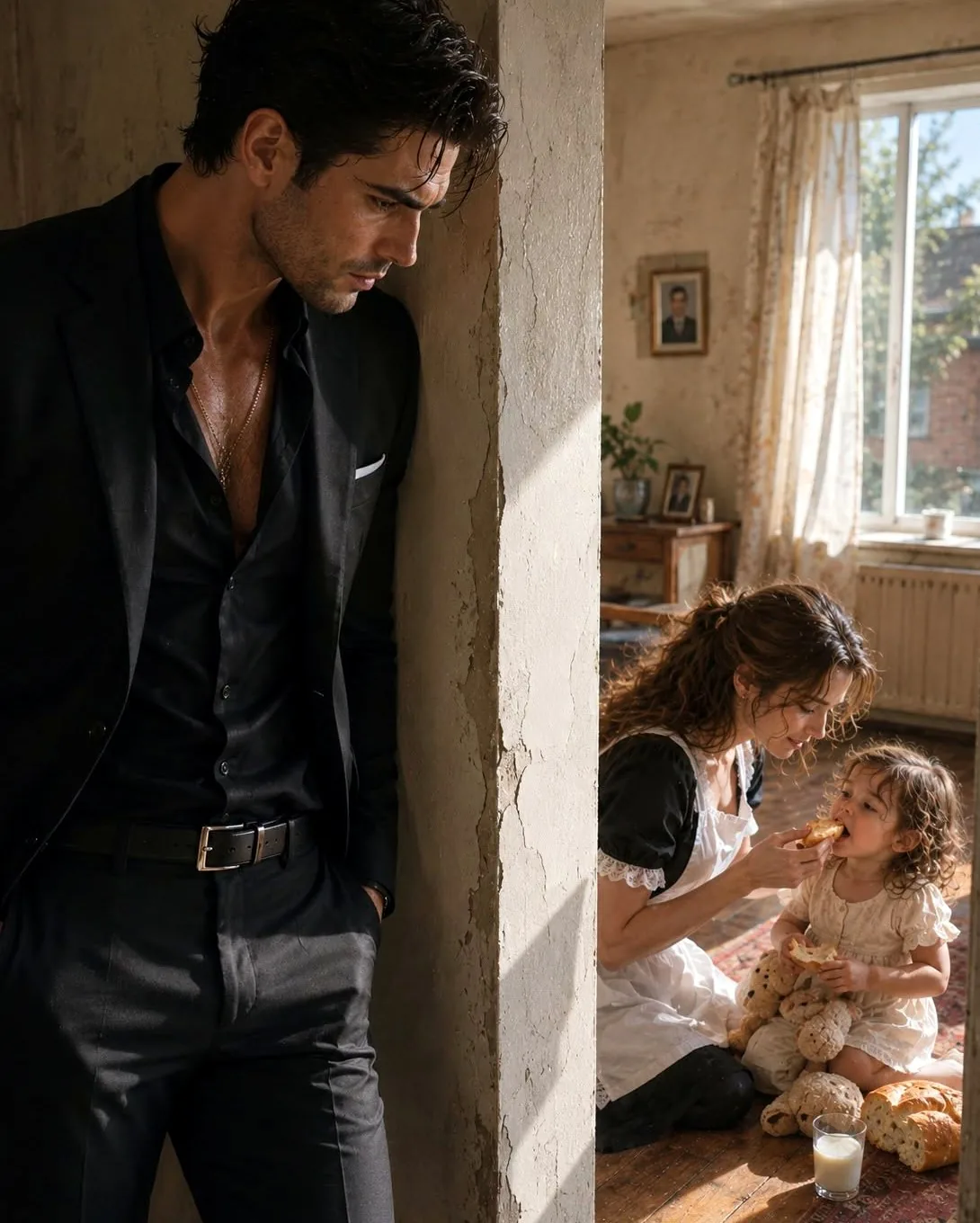
When I finally looked through the half-open door, I expected poverty. I expected fatigue. I did not expect the quiet mercy of a child trying to hold a family together with scraps of bread and hope.
What Emma Did With Almost Nothing
Inside that apartment, Emma carefully sliced the family’s last loaf of bread into two uneven pieces. She wrapped the larger half for her mother, kept the smaller piece for herself, and poured water into the final inch of milk as if she were stretching a miracle. Then she placed a faded photo of her late father beside the glass and whispered words that struck me harder than any threat I had ever faced.
She said, “I promised I’d take care of Mommy until she remembers how to smile.”
My hand hit the hallway wall before I even realized I had moved. My legs gave out on me for a second, because I had survived bullets, betrayals, and bloodshed without shedding a single tear—and yet that one sentence cracked something open that years of violence had not touched.
Emma was not just a child living in hardship. She was a child carrying grief too large for her small body, and doing it without complaint.
The House Built on Loss
Four months earlier, Sofia Romano had entered my mansion through the servants’ entrance with one suitcase and her daughter’s hand in hers. She was twenty-nine, with tired brown eyes, chestnut hair, and hands worn raw by bleach and endless work. My estate overlooked Lake Michigan, hidden behind towering iron gates, and held thirty rooms, marble staircases, and a private library that had become a monument to silence.
Three years before that, a car bomb meant for me had taken my wife Elena and our five-year-old daughter, Claire. They had been on their way to church without me because business had delayed my departure. Since that morning, I had replayed the same question a thousand times: if I had been in the car, would they still have lived?
Claire’s bedroom had remained untouched ever since. Her pink sweater still hung over a chair. Her favorite storybook stayed open beside the bed. Her yellow rain boots waited beneath the window, as if she might come back through the door one rainy afternoon and ask for a drink of water.
No one entered that room. No one even said her name.
The Rules I Gave Emma
When Charles Bennett told me the new housemaid had brought her little daughter to work, I made my rules clear. Emma stayed in the kitchen wing. She never entered the library, the dining room, or the upstairs hallways. And she never went near Claire’s room.
- Stay in the kitchen wing.
- Do not enter the upstairs hallways.
- Never go near Claire’s room.
Sofia answered every rule with a quiet “Yes, sir.” Emma, too, obeyed without complaint. Each morning she sat on a wooden stool beside the pantry, hugging a patched rag doll named Daisy. She never touched the expensive decorations, never begged for sweets, never cried when Sofia worked late, and thanked the cook for a single apple as though it were a feast.
One afternoon, Rosa whispered that the child acted like “a forty-year-old trapped inside a little girl’s body.” Hidden in the hallway, I stopped walking. Claire had once filled the mansion with laughter. Emma filled it with silence.
It was the silence of a child who had already learned that asking for anything only made life harder for her mother. Somehow, I understood that silence better than anyone.
Why the Little Girl Spoke to Me First
Late one night, I found Emma asleep on a small sofa after her rag doll had slipped to the floor. I picked it up and noticed one button eye and another stitched from blue thread, repaired countless times. When she opened her eyes, she did not cry out or ask who was there.
“Daisy gets scared when she sleeps alone,” she whispered.
I set the doll beside her and said, “Then she shouldn’t sleep alone.”
Her tiny smile caught me completely off guard.
“Thank you, Mr. Moretti,” she murmured.
I walked away before she could see my face. A man like me was not supposed to be affected by a child’s gratitude, and yet that brief exchange stayed with me far longer than any deal or threat ever had.
“I promised I’d take care of Mommy until she remembers how to smile.”
The Garden, the Rainwater, and the Photo
Sofia worked harder than anyone on my estate. She cleaned, washed, polished, and stayed late whenever guests arrived. She never asked for more money, even when holes opened in her shoes. One rainy evening, I heard her on the kitchen telephone, pleading to keep her apartment from being locked before she could catch up on rent.
When the call ended, she covered her mouth and cried as quietly as possible so Emma would not wake up. I stood unseen in the dark hallway and recognized the look of someone drowning while pretending to still breathe.
The next morning, before sunrise, I saw Emma walking toward Elena’s abandoned sunflower garden with an old metal cup hidden beneath her oversized sweater. Nobody had entered that garden since my family died. I almost ordered security to stop her.
Instead, I watched. She knelt beside the weeds, poured rainwater onto the forgotten soil, gently patted the earth, and whispered to it like it could hear her.
She returned the next morning. Then again the morning after that. On the fourth day, I hid behind the old stone wall before dawn, determined to understand what she was doing.
Emma placed a faded photograph of her late father against a rock, watered the empty flower bed once more, and smiled at the picture. Then she said something so soft I almost missed it.
“Flowers come back when you keep loving them.”
The words drained every ounce of strength from me. That child, who had so little, was tending dead ground as if she believed life could return if someone refused to give up on it.
What Stone Finally Understood
I had spent years believing grief made a man strong because grief taught him to survive without needing anyone. But standing there in the cold, watching Emma care for a garden no one else thought was worth saving, I understood something I had avoided for too long: survival was not the same as living.
Claire’s room, Elena’s absence, the silence in that mansion, the weight I carried every day—it had all been a locked door I refused to open. Emma did not unlock it by force. She did it by simply being small, honest, and unafraid to hope in a place that had forgotten how.
That night, I looked back at the house with its marble stairs and frozen rooms and realized it had become a grave for more than two loved ones. It had become a grave for the part of me that still believed tenderness belonged somewhere in my life.
Emma had not asked for rescue. Sofia had not asked for pity. But both of them had stepped into my world and revealed the same truth: grief may change a person, but it does not have to erase every trace of them.
Conclusion
Chicago still knew me as Stone, and perhaps it always would. Yet after that night, the name felt less like armor and more like a confession. Under the fear, the guns, and the stories people told about me, I was just a man standing in the wreckage of what he had lost.
And in the middle of all that wreckage, a little girl with a patched doll, a faded photograph, and a cup of rainwater showed me that even the coldest places can remember how to grow again.